The procedure a regulator asks to see.
How your workplace identifies psychosocial hazards, how workers report them, what happens in the first hours, how they are investigated and controlled, and how you know it is working — written for your industry and your jurisdiction.
Psychosocial Hazards Procedure — $99 inc GST, one-time. No subscription.
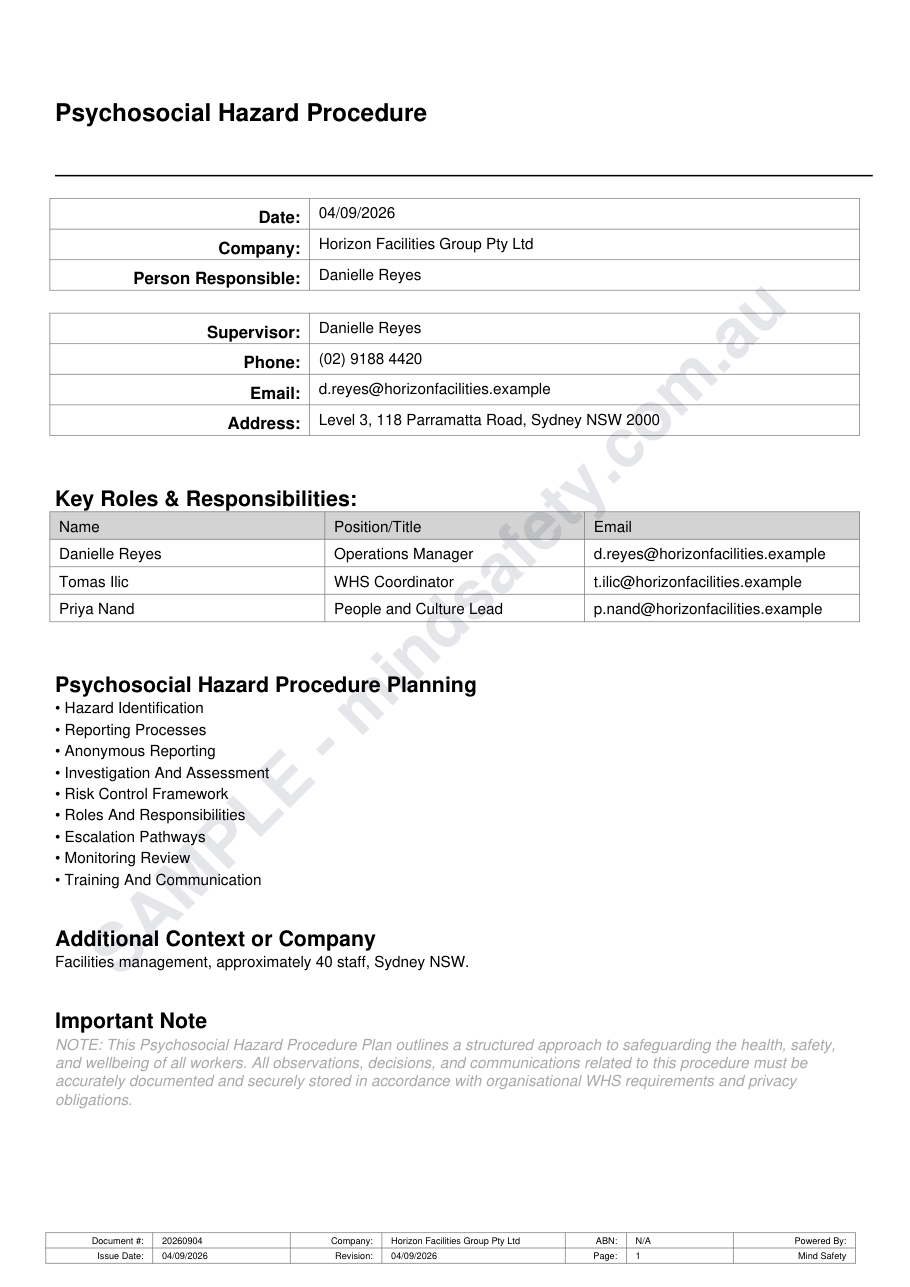
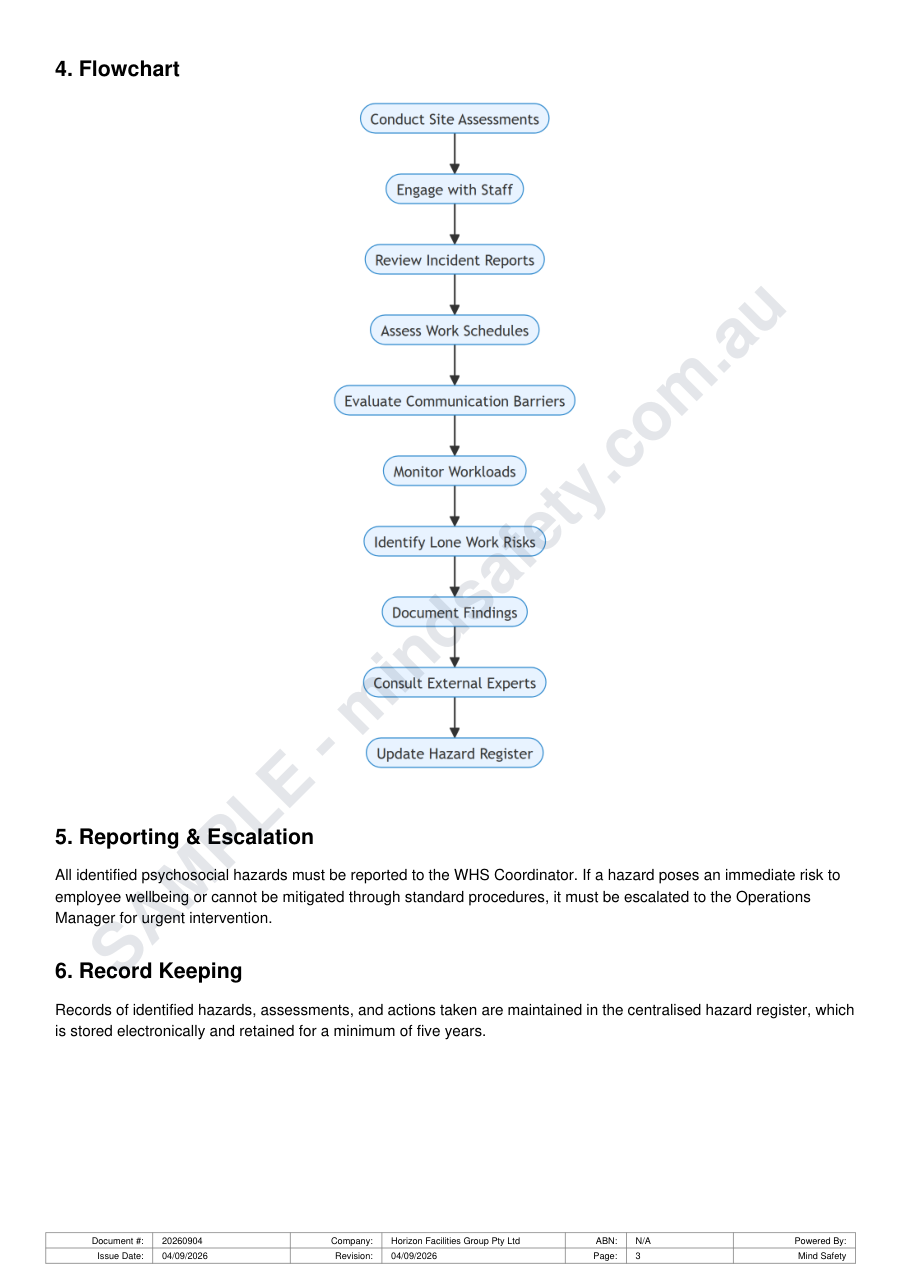
Twelve sections, and the flowcharts that make them usable
A procedure is a process document. Yours is built around diagrams a supervisor can follow on the day, not paragraphs nobody reads.
Finding hazards
Purpose and scope, definitions, roles and responsibilities, and how psychosocial hazards are identified before they cause harm.
When something happens
Reporting — informal, formal and anonymous — the initial response in the first hours, and how a report is investigated.
Keeping it working
Risk control and review, worker support and consultation, training and communication, monitoring, and the records you keep.
Written for your workplace, not for a template
- Names your regulator and the code of practice for your state or territory.
- Uses your industry's language — your workers, your settings, your reporting channels.
- Names the roles that actually exist at your size, from a three-role small business up to an organisation with a WHS officer and health and safety representatives.
- Carries your logo on every page.
- Four process flowcharts: reporting and escalation, the initial response decision, the investigation sequence, and the review cycle.
- A roles and responsibilities matrix, plus a diagram of the reporting line.
- Document control, contents, sign-off and consultation records.
- Cites your Psychosocial Risk Assessment if you have one, so the two documents agree.
Your state, named in the document
You tell us where you operate. The document is written to that jurisdiction and names your regulator and the code of practice or guidance it is structured around, so whoever reads it can see which framework it was written for.
- Australian Capital Territory WorkSafe ACT Work Health and Safety Act 2011 (ACT)
- New South Wales SafeWork NSW Work Health and Safety Act 2011 (NSW)
- Northern Territory NT WorkSafe Work Health and Safety (National Uniform Legislation) Act 2011 (NT)
- Queensland Workplace Health and Safety Queensland Work Health and Safety Act 2011 (Qld)
- South Australia SafeWork SA Work Health and Safety Act 2012 (SA)
- Tasmania WorkSafe Tasmania Work Health and Safety Act 2012 (Tas)
- Victoria WorkSafe Victoria Occupational Health and Safety Act 2004 (Vic)
- Western Australia WorkSafe WA Work Health and Safety Act 2020 (WA)
Most states and territories work from the model WHS laws; Victoria runs its own Occupational Health and Safety Act 2004 (Vic), and the document reflects that rather than pretending the frameworks are identical. Operating across borders is fine — say so in the intake and the document covers each place you work. Mind Safety documents are designed to support your obligations and are aligned with the relevant code of practice; they are not certified or endorsed by any regulator.
Ready when you are.
See a complete sample procedure, or start yours now.
Mind Safety documents are designed to support your obligations under Australian WHS law and are structured around Safe Work Australia's model Code of Practice Managing psychosocial hazards at work. They are not a certification and do not replace advice about your specific circumstances.